

Disclaimer: This post may contain affiliate links, meaning we get a small commission if you make a purchase through our link at no extra cost to you. For more information, please visit our Disclaimer Page.
“Whether you think you can, or you think you can’t — you’re right.” — Henry Ford
What if the very thing you’ve been chasing — that unshakeable, walk-into-any-room confidence — has been inside you this whole time?
Most people chase confidence without ever understanding what’s underneath it. And until you do, every win feels temporary and every setback knocks you flat.
This isn’t another “just believe in yourself” post. This is the honest, been-in-the-trenches breakdown of self belief and self confidence — what they actually are, how they work together, and why the difference changes everything.
Table of Contents
Self Belief and Self Confidence: The Real Difference
This is the core of everything — and most people get it completely wrong.
For years, I used those two words interchangeably. That confusion cost me years of spinning in circles.
Self-belief is internal. Confidence is external.
Self-belief is the deep, quiet knowing that you are worthy and capable — before you have a single result to show for it. It doesn’t need a win, applause, or anyone’s approval to exist.
Think of it as the root system of a massive tree. You can’t see the roots, but they’re the reason the tree survives every storm.
Confidence, on the other hand, is situational and earned. It’s the trust you build in yourself because you’ve practiced something, prepared for it, or done it before.
Confidence says: I feel ready for this presentation because I’ve rehearsed it ten times. It grows from evidence.
Here’s the problem with confidence alone — it’s fragile. One big win and it shoots up. One rejection and it crashes.
If confidence is all you’ve got, you’re one hard day away from unraveling.
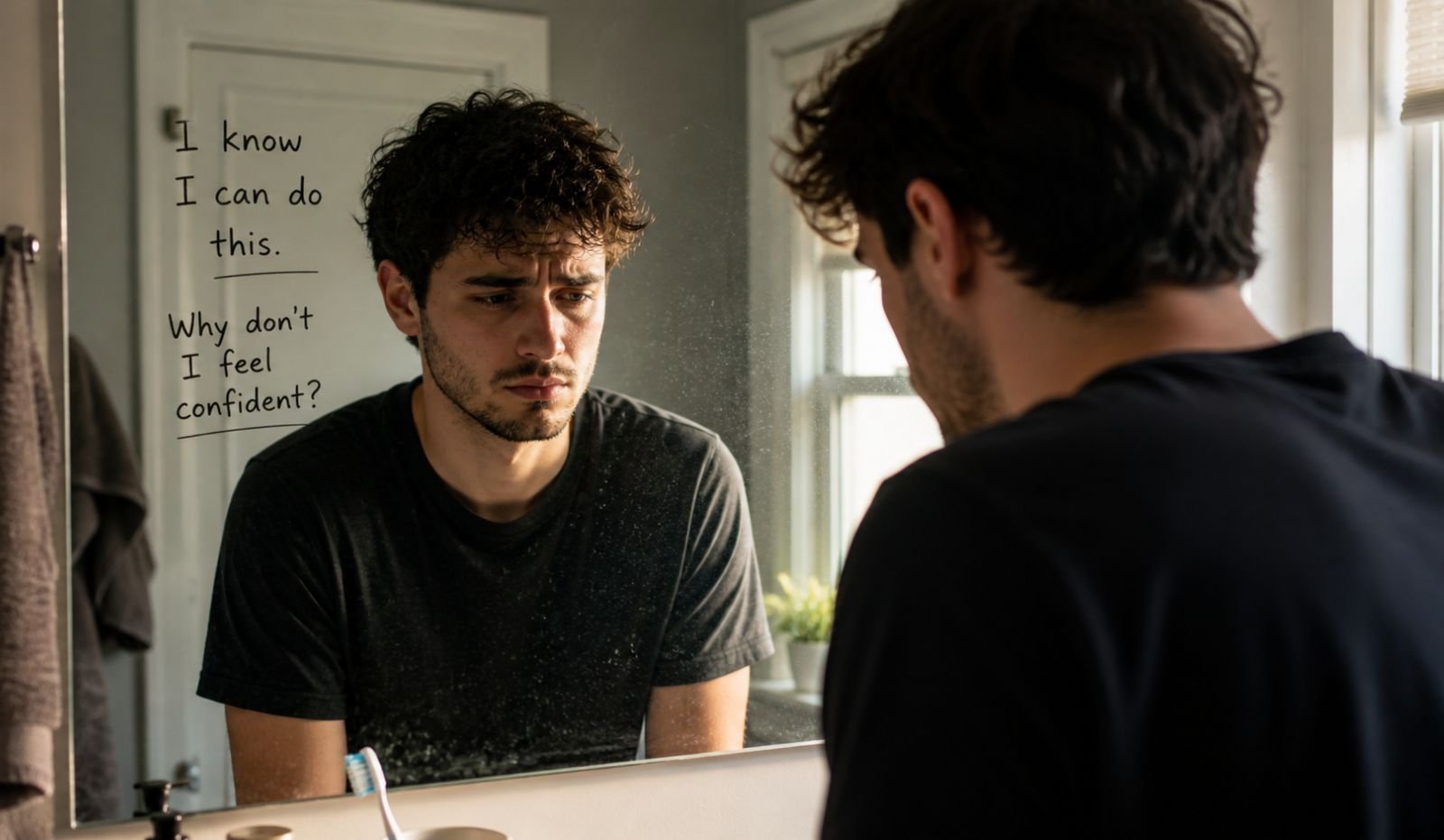
I know this personally. I have a stutter and I talk fast when I’m nervous. When I first posted YouTube videos, I’d watch the playback, hear my voice, and just cringe.
My confidence was nowhere. But underneath that? A quiet, stubborn nudge kept whispering: Davian, you can do this.
That was self-belief. It didn’t need my videos to be perfect — it just needed me to keep moving.
The moment I stopped letting external evidence be the whole story, everything shifted. Self-belief kept me going when confidence didn’t show up, and over time, confidence grew because I was building real proof.
You need both. Self-belief is the root. Confidence is the fruit.
| Self-Belief | Self-Confidence | |
|---|---|---|
| Source | Internal — your sense of worth | External — built from experience |
| Requires proof? | No | Yes |
| Affected by failure? | Stable (if developed) | Can drop significantly |
| Built by | Identity work, mindset shifts | Action, practice, wins |
| Role | Keeps you going when results don’t show | Helps you perform in specific moments |
What Are the Signs of Low Self-Belief?
Low self-belief doesn’t always announce itself loudly. Sometimes it’s the quietest voice in the room — and it’s been running your decisions for years.
Here are the signs. Be honest as you read them.
You wait for permission. Before you post, apply, or speak up — you look around hoping someone else will cosign it first. You need a green light from outside before you trust your own instincts.
You minimize your wins. A compliment lands and your first instinct is to deflect it. You’ve trained yourself to shrink in the face of your own success.
Failure feels final. One setback and the narrative immediately becomes: this is proof I was never capable. Not information. A verdict.
You constantly compare. You measure your chapter one against someone else’s chapter twenty and wonder what’s wrong with you. If this one hit home, stop comparing yourself to others is worth your time.
You self-sabotage right before a breakthrough. Things are going well and suddenly you find a reason to slow down or pull back. This is one of the sneakiest forms of self-sabotage — and it’s more common than you think.
You apologize for taking up space. In conversations, in rooms, in your own life — you consistently make yourself smaller. You preface opinions with “this is probably a dumb idea, but…”
If you recognized yourself in any of those — that’s not a verdict. That’s just where you’re starting from.
Now we build.
The 4 Pillars of Self-Confidence
Confidence isn’t a personality trait. It’s a structure — and like any structure, it has pillars holding it up.
Get these right and everything becomes stable. Ignore one and the whole thing leans.
Pillar 1: Self-Awareness
You can’t build confidence on a foundation you don’t understand. Self-awareness means seeing yourself clearly — your strengths, your patterns, and where you tend to retreat under pressure.
Journaling is one of the most direct routes to this kind of clarity. The free journal prompt generator is a practical starting point if you don’t know where to begin.
Pillar 2: Competence
Competence is doing the thing — repeatedly — until you have real evidence you can handle it. You don’t feel confident before you’re competent; you feel confident because you’ve put in the reps.
Stop waiting to feel ready. Feel ready by getting ready.
Pillar 3: Connection
Isolation shrinks confidence. Community expands it.
The people around you — a mentor, a coach, a friend who genuinely sees you — contribute to your belief in yourself more than most people realise. Research from the International Coaching Federation consistently shows self-confidence is one of the top reasons people seek coaching.
Pillar 4: Courage
Confidence isn’t the absence of fear. It’s the decision to move despite it.
Without courage, awareness, competence, and connection just sit there. If how to stop living in fear is something you’re working through, that’s the exact muscle this pillar is asking you to build.
The 5 C’s of Confidence
The 5 C’s aren’t a checklist — they’re a cycle. Each one feeds the next.
1. Clarity
Know what you’re building toward. Vague confidence doesn’t exist.
The people who seem most certain of themselves aren’t necessarily more talented — they’re just clearer on who they are. Remembering who you are is the inner work that creates this.
2. Commitment
Confidence is built by people who show up consistently — not just when they feel inspired. It’s keeping promises to yourself even on the low-energy days.
These positive affirmations for self-discipline are a solid anchor for the days when commitment feels hard.
3. Courage
Act before you feel ready. The nerve will always be there before a big moment — the move is to go anyway.
4. Capability
Every time you do something hard, you expand the evidence that you’re capable. Every time you expand that evidence, capability compounds.
It’s a growth cycle, not a finish line.
5. Consistency
This is the one people underestimate most. Confidence isn’t built in one dramatic moment — it’s built in the accumulation of small daily decisions.
Your monthly reset routine keeps consistency from being an abstract idea and turns it into a real practice.
The 4 C’s of Confidence
The 4 C’s zoom in on the psychological side — how confidence actually feels in the body and mind.
Competence — the evidence layer. What have you done, practiced, and proven you can handle?
Composure — the ability to regulate your emotional state under pressure. It’s not about being cold — it’s about knowing how to reset when anxiety spikes, and then doing it.
Connection — your relationship with yourself and others. How you talk to yourself internally. Whether the people around you see your potential or diminish it.
Character — your values and integrity in action. Confidence built on character doesn’t require an audience. You know your worth not because someone confirmed it — but because your actions confirm it daily.
How to Have Self-Belief and Confidence: 5 Steps That Actually Work
Mindset is the foundation. Action builds the house.
Here are five tools you can use starting today.
Step 1: The 60-Second State Reset
You’re heading into a moment that matters and confidence is nowhere. That’s okay — you don’t need to feel confident to act confidently.
In 60 seconds: stand tall, force a smile, make one powerful physical movement — shoulders back, deep breath — then say one sentence out loud that you actually believe: “I know what I’m doing. I’m ready for this.”
This isn’t fake-it-till-you-make-it. This is neurologically shifting your state.
Confidence is a feeling you can learn to summon — not just one you wait to receive.
Step 2: Build Your Belief Bank
Trust is built through evidence. If you want to trust yourself, you need proof that you follow through on what you tell yourself.
Start tiny: drink water when you wake up, write for 10 minutes, make the one phone call you’ve been avoiding. Every kept promise is a deposit — and over time, those deposits stack into unshakeable self-trust.
This is the real backbone of how to motivate yourself — not hype, just small kept promises compounding into something solid.
Step 3: Record Your Own Voice Over Yourself
A lot of people struggle with self-belief because they never heard what they needed to hear growing up. No one looked them in the eyes and said: You are capable. You are enough.
Here’s what you can do right now: write down the phrases you wish someone had said to you, then record yourself saying them on your phone and listen daily. Your own voice speaking belief over your own life hits different — your brain believes what it hears repeatedly.
These positive affirmations to build self-esteem give you the exact language to start with.
Step 4: Borrow Someone Else’s Belief
What if you genuinely can’t get there today? What if the doubt is too loud?
Find someone — a mentor, a coach, a friend who sees you clearly — and lean on their belief until yours catches up. Tell yourself: I don’t fully believe it yet, but they do — and I’m borrowing that until mine grows.
The benefits of asking for help are real, and this is one of the most underrated forms of it.
Step 5: Change Your Relationship With Failure
Low confidence leads to avoiding risk. Avoiding risk means no new wins. No new wins means confidence drops lower.
Break the cycle by deliberately changing what failure means — set a stretch goal, go after it, and when it doesn’t go perfectly, look yourself in the mirror and say: You showed up. That matters. You’re training your brain to understand that your worth is not decided by your results.
If you’re working through a specific setback right now, how to get over disappointment walks through it honestly.
My Story: The Moment Everything Shifted
I was always the guy with social anxiety. Not the kind where I couldn’t function — just a low hum underneath everything, always there.
Walking into a room full of strangers? The nerves were real. The temptation to find the nearest corner and count down until the event ended? Extremely real.
What changed wasn’t that the nerves went away. What changed was that I stopped trying to conquer the whole room.
I just looked for one person — or one small group — who seemed open, warm body language, people laughing. Then I’d walk over and say the most simple thing: “You guys seem fun. Can I join you?”
Every single time, it worked. Not because I was suddenly the most magnetic person in the room — but because I changed the mission from “impress everyone” to “make one real connection.”
That reframe was everything. If getting over social anxiety is something you’re actively working through, that shift in thinking is exactly where to start.
And here’s the honest part — I still work on the follow-up. Showing up is one skill. Staying connected afterward is a completely different one, and it’s one I’m still building.
Self-belief and confidence aren’t destinations. They’re practices — and every day you choose them, they get stronger.
The Decision You Can Make Right Now
Confidence is an inside job. Full stop.
You do not need to fix your stutter, lose the weight, get the promotion, or hit 10,000 subscribers first. You can make the decision — right here, right now — that you are enough.
If you truly believed that, how would you act differently? What would you stop waiting for?
Start there. Keep the small promises. Walk over to the group. Post the video. Apply for the role. The verses about self-worth are a powerful reminder on the days when the world tries to tell you otherwise.
The moment you understand the difference between self-belief and confidence — and stop letting one collapse the other — your whole life shifts. You stop seeing yourself through the lens of what you couldn’t do. You start seeing yourself through the lens of who you’re becoming.
You have the capacity to be great. Not someday. Now.
Start today.
Want to go deeper? Explore ways to boost confidence for more tools, use meditations for self-confidence as a daily practice, or dig into your self-image issues honestly — because seeing it clearly is already the beginning of something new.