


Disclaimer: This post may contain affiliate links, meaning we get a small commission if you make a purchase through our link at no extra cost to you. For more information, please visit our Disclaimer Page.
The qualities of a true friend become easier to see when you stop counting who texts you most and start watching what people do over time.
I take my time getting to know people. I’m an introvert, so I notice the little things: how somebody speaks about a person who is not in the room, how they react when I need space and how they behave when doing the kind thing gains them nothing.
That has changed the way I think about friendship.
Someone can make you laugh and still be the wrong person to trust with your private life.
Someone can talk to you every day and still disappear when life gets inconvenient.
Someone else may not text daily, yet you know that if you called and said, “I need you,” they would take you seriously.
That is why this post is not only a list of nice personality traits.
It is about patterns.
The things people repeat.
The way you feel around them.
The way they act after disagreement.
The way they treat your private life.
And yes, the way you treat them too.
Table of Contents
Key takeaways
- Trust grows through repeated behaviour.
- You should not need to become another version of yourself to keep a friendship.
- A true friend respects privacy, limits and differences.
- Loyalty does not require blind agreement.
- Listening is different from waiting for your turn to talk.
- Support can be emotional or practical.
- Strong friendships still have disagreement.
- A real apology needs changed behaviour after it.
- Friendship needs give and take across time.
- A healthy friendship can survive quiet seasons.
- One bad day does not define a friendship, but repeating hurt deserves your attention.
- The friendship test goes both ways: you also need to ask what kind of friend you are becoming.
What Actually Makes Someone a True Friend?
You can like somebody without trusting them.
You can have fun with somebody without feeling safe telling them what kept you awake last night.
You can also have a huge contact list and still wish you had one person who knew the unedited version of you.
The American Friendship Project surveyed U.S. adults and college students and found something worth paying attention to: more than 75 per cent were satisfied with the number of friends they had, yet over 40 per cent said they wanted greater closeness with their friends.
So having people around you and feeling deeply known are not the same thing.
An adult friendship review covering 38 studies found links between friendship quality, time spent with friends and well-being. The research also describes adult friendship as reciprocal and notes emotional, practical and informational forms of friend support.
The CDC social connection guidance also explains that supportive relationships can give emotional and practical help and can play a role in stress, sleep and emotional health.
That takes us beyond:
“They are nice.”
Nice is good.
I want you to look deeper.
The Qualities of a True Friend Show Up in Patterns
Your original post named seven traits that still deserve to stay:
- Being yourself.
- Emotional safety.
- Loyalty.
- Empathy and listening.
- Practical support.
- Respect for differences.
- Caring honesty.
I am keeping all seven.
I am also taking each one beyond a description so you can see what it looks like when friendship leaves the page and enters real life.
1. They Let You Be Yourself
You know how exhausting it feels when you keep checking yourself around somebody.
Was that joke too much?
Did I talk too little?
Should I have stayed longer?
Do they think I’m boring because I would rather be home by 9 p.m. than shouting over music at midnight?
I have always needed time to process people and relationships.
I need alone time. Big groups drain me faster than quiet one-to-one conversations. A real friend does not turn that into a personal attack against them.
What this looks like
You can say:
“I’m staying home tonight.”
And the friendship does not go into emergency mode.
You can disagree about music, social plans, work, hobbies or personality.
You can be quiet.
You can think before answering.
You can have parts of your life that do not include them.
A true friend learns who you are instead of constantly trying to edit you.
What this does not mean
Acceptance does not mean:
“You must accept every choice I make.”
A friend can respect you and still tell you that something you did hurt them.
They can love your personality and still ask you to work on a behaviour that affects the friendship.
There is a difference between:
“Change who you are so I can like you.”
and:
“I care about you, but this behaviour is hurting me.”
If you have spent years changing yourself to keep other people comfortable, understand your true self is a natural next read.
2. You Feel Safe Telling Them Something Private
Trust normally grows in small deposits.
You tell someone something personal.
They keep it personal.
You admit you are worried.
They do not turn it into a joke three months later.
You tell them:
“I’m not ready for anyone else to know.”
And the story does not somehow travel across town before dinner.
Your original post already made emotional safety one of the centre points of friendship: being able to share fears, doubts and late-night thoughts without expecting somebody to use them against you later.
Privacy is part of trust
Being close does not give somebody automatic entry into every room of your life.
You are allowed to say:
“I don’t want to talk about that yet.”
A healthy friend does not treat privacy as rejection.
They let trust grow.
Watch what they do with other people’s secrets
Pay attention when somebody regularly tells you things that were clearly not theirs to share.
If every private story somehow reaches their mouth, you have learned something.
Do not wait until it is your story.
3. They Stay Steady When Friendship Becomes Less Convenient
Anybody can enjoy you when you are funny, available and having a good week.
Friendship feels different when you are tired.
When work drains you.
When you are slower to reply.
When your mood has changed.
When you have no entertaining story to tell.
Your original article said that loyalty becomes clearer when somebody stays present through the harder parts instead of appearing only for the easy ones.
Loyalty does not mean constant access
A loyal friend can still have a job.
A family.
A partner.
A need for rest.
Their own problems.
They do not need to answer every message in four minutes.
Look for return.
Look for care.
Look for the longer pattern.
A message such as this can say a lot:
“No pressure to reply. Just checking on you.”
Loyalty does not mean blind agreement
Someone is not disloyal because they refuse to defend something you did wrong.
A good friend can say:
“I love you, but I cannot back you on this.”
That can be friendship too.
4. They Listen Instead of Waiting to Speak
You start telling a story.
You are three sentences in.
And suddenly your friend has somehow turned your problem into a 20-minute documentary about themselves.
We have all been on at least one side of that conversation.
Good listening asks us to stay with the other person for a minute.
A 2026 study on listening ran five studies with 1,624 participants. People who experienced stronger listening during disagreement reported better momentary well-being and stronger feelings of connection than people who received weaker listening.
Another 2024 study found that people can mistake disagreement for poor listening, even when the listener’s actual listening behaviour stays the same.
That matters in friendship.
Your friend can hear you and still disagree.
Ask what kind of help they need
One sentence can change the conversation:
“Do you want me to listen, help you think this through or help you do something?”
Now you do not need to guess.
Maybe they want advice.
Maybe they want action.
Maybe they want to hear:
“That sounds rough.”
And then sit there for a minute.
5. Their Care Turns Into Action
There is nothing wrong with saying:
“Let me know if you need anything.”
But sometimes your friend is so tired that figuring out what to ask for feels like one more job.
Specific care can make life easier.
Try:
“Do you want me to bring dinner?”
“Want me to drive you?”
“Want company while you fill that out?”
“Do you want company or quiet?”
Your original article included the same idea: friendship support can be coffee, a check-in, quiet company or noticing what might help before the person has to make a speech about it.
The adult friendship review separates friend support into emotional, practical and informational forms.
Small acts still count
It can be:
- remembering the interview date;
- sending notes after they miss something;
- checking that they got home;
- bringing coffee;
- helping move one heavy box;
- sitting quietly when words are not helping;
- sending the information they asked for.
You do not need a movie scene.
Sometimes friendship looks suspiciously similar to carrying a grocery bag.
6. They Respect Boundaries and Differences
A friend does not need to think exactly like you.
They can enjoy different music.
Vote differently.
Spend differently.
Need more social time.
Need less social time.
Have other friends.
Spend time with their partner.
Enjoy hobbies you cannot understand even after they have explained them three times.
The question is:
Can both of you stay respectful without trying to control the other person?
Boundaries that can exist in friendship
You can say:
“I can’t come tonight.”
“I need some quiet.”
“I’m not discussing that.”
“Please stop joking about that.”
“I can help tomorrow, not tonight.”
Your friend gets boundaries too.
A no does not automatically mean rejection.
If boundaries are hard for you to say without guilt, these positive affirmations for boundaries can help you practise the language before a harder conversation.
Introverts need room too
Needing quiet does not mean you hate people.
Sometimes it means you have had enough people for one day.
If solitude helps you reset instead of leaving you cut off from everybody, read about the benefits of quiet solitude.
7. They Tell You the Truth With Care
The easiest friend to keep around may be the one who agrees with everything.
That does not always make them good for you.
Sometimes friendship sounds like:
“I care about you, so I need to tell you something.”
Sometimes it sounds like:
“I think you were wrong there.”
Sometimes:
“What happened yesterday hurt me.”
Your original post already made a strong distinction between caring honesty and using “brutal honesty” as permission to be cruel.
Good conflict is not a screaming match
A 2024 intellectual humility study found that people who were more willing to accept that their own thinking could be wrong were more likely to respond constructively during conflicts with friends and family.
That sounds simple.
It is not always easy.
Sometimes the sentence friendship needs most is:
“I could be wrong. Tell me how you saw it.”
Repair needs more than sorry
A useful apology can sound like:
- “I was wrong.”
- “I understand why that hurt.”
- “I’m sorry.”
- “I’ll handle that differently.”
Then comes the part that counts.
What happens next time?
A 2024 constructive confrontation study found that people often expect direct conversations about relationship problems to go worse than they actually do. Those expectations can keep people from starting conversations that might help repair the relationship.
Newer spoken disagreement research published in 2026 found that spoken disagreements led to greater understanding and lower conflict than written disagreements on average across the experiments.
So that 14-paragraph text you are preparing at 1:12 a.m. may not be your finest friendship plan.
Call when you can.
Talk when it is safe.
Listen too.
The Friendship Test People Forget: Reciprocity
The qualities of a true friend also have to work in both directions.
It is easy to read seven traits and start privately grading everybody you know.
A harder question is:
What am I giving back?
Your original post already says these traits are not only qualities you seek in other people. They are things you are working to become yourself.
That part stays.
Reciprocity is not perfect 50/50 maths
Friendship has seasons.
One person may need more help for a month.
Someone may be grieving.
Studying.
Caring for a parent.
Working double shifts.
Recovering from illness.
The goal is not:
“I called twice, so you owe me two calls.”
Look across time.
Ask:
- Do both people ask questions?
- Do both initiate sometimes?
- Can both ask for help?
- Can both say no?
- Can both celebrate good news?
- Can both apologise?
- Does one person carry every difficult conversation?
- Is one person expected to be endlessly available?
If one person constantly pours and the other constantly arrives with an empty cup, pay attention.
Can a True Friend Disagree With You?
Yes.
Agreement is not the price of admission.
A friend can think your decision is wrong and still respect your right to make it.
A friend can have another opinion and still listen carefully.
Remember the study on listening: strong listening still mattered during disagreement.
Try:
“I see this differently, but I want to hear why you feel that way.”
Or:
“I disagree with what you did. I still care about you.”
The better friendship question is not:
“Do we disagree?”
It is:
“What happens to our respect when we disagree?”
Should a True Friend Always Be Available?
No.
A friend can love you and still be:
- asleep;
- working;
- parenting;
- studying;
- resting;
- spending time with their partner;
- dealing with something private.
Constant access and closeness are not the same thing.
The American Friendship Project also found that a large share of respondents wanted more time or greater closeness with friends, even while most were satisfied with the number of friends they had.
Look for return.
If they miss the call, do they come back when they can?
If they cannot meet, do they sometimes suggest another day?
If they need space, can they say so without punishing you?
Your phone is not a friendship ankle monitor.
How Long Does It Take to Know Someone Is a True Friend?
There is no honest three-week formula.
Time helps because patterns need time to repeat.
Years alone do not prove character either.
Watch somebody:
- when you say no;
- when they are irritated;
- when you do well;
- when they do well;
- when plans change;
- when you need help;
- when they need help;
- when you disagree;
- when somebody else leaves the room;
- when there is nothing in it for them.
Let time answer some questions that excitement cannot.
If meeting people is hard before friendship even gets started, read this help with social anxiety.
What Does a One-Sided Friendship Look Like?
Do not judge a friendship from one forgotten birthday.
Do not turn one delayed reply into a character trial.
Look for repetition.
Pay attention when somebody:
- calls mainly when they need something;
- shares private information;
- treats your good news like a competition;
- keeps joking about something after you asked them to stop;
- demands quick replies but ignores you for long stretches;
- gets angry when you spend time with someone else;
- expects you to break boundaries as proof of loyalty;
- disappears each time your life becomes hard;
- expects help they rarely return;
- refuses to apologise;
- makes disagreement feel dangerous.
A healthy friendship still includes mistakes.
The question is what both people do after the mistake.
Can a Real Friendship Still End?
Yes.
A friendship can have been real and still reach an ending.
People move.
Schedules change.
Priorities shift.
Some friendships become quieter.
Some end after hurt that never gets repaired.
Some people simply grow in different directions.
The length of a friendship tells you how long it existed.
It does not automatically tell you how healthy it was.
You can be thankful for what a friendship once meant without forcing it into the same shape forever.
If the ending keeps replaying in your mind, getting over past regret can help you work through your side of the story.
What Faith Teaches Me About Friendship
When I think about the qualities of a true friend through faith, I think about love that moves.
Proverbs 17:17 says:
“A friend loveth at all times, and a brother is born for adversity.”
It does not say a friend agrees at all times.
Proverbs 27:6 says:
“Faithful are the wounds of a friend.”
A good friend may say something uncomfortable because they care about where your decision is taking you.
Faith also sends the question back towards me.
Am I patient with my friends?
Do I keep private things private?
Can I celebrate when they win?
Can I apologise?
Do I respect their limits?
Am I praying for good friends while refusing to become a good friend myself?
Prayer belongs here.
So does action.
How to Be the Friend You Want to Find
Now turn the list around.
Ask yourself:
- Do I keep private things private?
- Do I listen?
- Do I respect no?
- Do I make room for differences?
- Do I celebrate their success?
- Do I check in without demanding an answer?
- Can I tell the truth without trying to embarrass them?
- Can I apologise?
- Do my actions change after the apology?
- Can they have other friends without me becoming threatened?
- Can they need space?
- Can I admit when I got something wrong?
I have learned to be selective about friendship because my energy is not endless.
But being selective does not mean expecting everybody else to meet standards I refuse to practise myself. That reciprocal idea was already one of the strongest parts of your original article.
Seven Questions to Ask About One Friendship Tonight
Pick one friendship you genuinely want to understand.
Not the person you are angry with tonight just so you can use the list as evidence.
Ask:
- Can I be myself around this person?
- Do private things stay private?
- Does care continue during inconvenient seasons?
- Do I feel heard?
- Does care become action sometimes?
- Can both of us have boundaries?
- Can we tell the truth and repair hurt?
Now answer the same seven questions about yourself.
That second set may be the one you needed.
20 True Friend Quotes Worth Keeping
The source article already had 20 friendship quotes, so I am not cutting that useful section down.
- A true friend never asks you to audition for a place in their life.
- Good friendship gives you room to speak, laugh, disagree and still be respected.
- A true friend protects your name in rooms you never entered.
- The friend who understands your quiet has spent time learning you.
- Real friendship does not need daily contact to keep daily care.
- A good friend can celebrate your win without turning it into a competition.
- Trust grows each time your private story stays private.
- A friend who respects your no makes your yes feel safer.
- Good friends notice when your words change.
- Loyalty can still tell the truth.
- A friend can give you space without making you pay for needing it.
- You learn a lot about friendship when helping becomes inconvenient.
- Good friends can disagree without letting respect disappear.
- An apology matters more when behaviour changes after it.
- A friend who asks what you need may help more than one who guesses.
- You do not need 20 close friends to know you are cared for.
- Healthy friendship has room for two people to need, give, rest and grow.
- Some friends cheer loudly. Some sit quietly beside you. Both can be love.
- A real friend does not turn your weakest hour into somebody else’s story.
- Becoming a better friend is part of finding better friendship.
Questions People Ask Next
Can a true friend be jealous of you?
Yes, a friend can feel jealousy.
People are human.
Look at what happens next.
Can they deal with their own feeling without punishing you for doing well?
Can they congratulate you?
Can your good news stay good news?
Can somebody be a true friend if you rarely talk?
Yes.
The friendship may still be close if both people understand the rhythm, care remains and you can reconnect without guilt games.
Is arguing normal between friends?
Disagreement can happen in healthy friendships.
Look at how you speak, listen, apologise and act afterward.
What if I always text first?
Look across time.
A short season may mean your friend is overloaded.
A long pattern where you start every conversation, arrange every meeting and carry every repair may point towards a one-sided relationship.
What if my friend talks about everybody else?
Pay attention.
If somebody regularly repeats other people’s private stories, do not assume yours has special security clearance.
What if I do not have a close friend right now?
Do not use this article to beat yourself up.
Start smaller.
Talk to the person you already enjoy.
Ask someone for coffee.
Return a message.
Join something that meets regularly.
Follow up after a good conversation.
Friendship often grows through repeated contact before it grows into trust.
Free True Friend Quote Prints
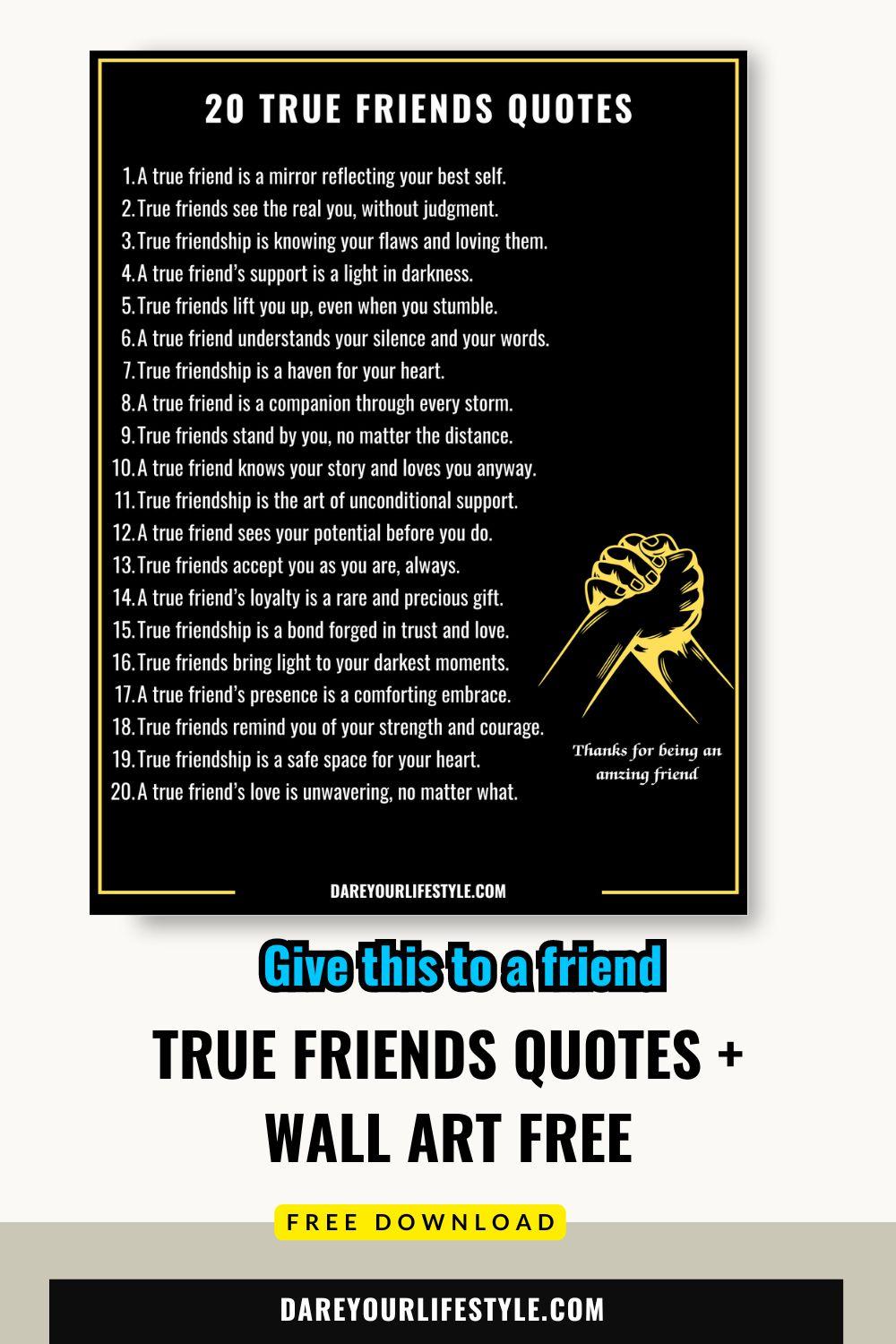
Enter your best email below and we’ll send you the Free True Friend Quotes Wall Art.
20 True friends quotes
- A true friend is a mirror reflecting your best self.
- True friends see the real you, without judgment.
- True friendship is knowing your flaws and loving them.
- A true friend’s support is a light in darkness.
- True friends lift you up, even when you stumble.
- A true friend understands your silence and your words.
- True friendship is a haven for your heart.
- A true friend is a companion through every storm.
- True friends stand by you, no matter the distance.
- A true friend knows your story and loves you anyway.
- True friendship is the art of unconditional support.
- A true friend sees your potential before you do.
- True friends accept you as you are, always.
- A true friend’s loyalty is a rare and precious gift.
- True friendship is a bond forged in trust and love.
- True friends bring light to your darkest moments.
- A true friend’s presence is a comforting embrace.
- True friends remind you of your strength and courage.
- True friendship is a safe space for your heart.
- A true friend’s love is unwavering, no matter what.
On A Final Note
A true friend is a rare and precious gem, embodying qualities that make them an invaluable part of your life.
They stand by you through thick and thin, offering unwavering support, active listening, and endless patience.
Their empathy helps you feel understood, while their strength provides stability during tough times.
Confidentiality ensures your deepest feelings are respected, and their genuine nature fosters a deep, authentic connection.
True friends uplift you, inspire confidence, and shine a light on your path forward.
If you have a friend who exemplifies these wonderful traits, let them know how much they mean to you.
Share this with them and consider giving them a free wall art decor as a heartfelt token of your appreciation.
Which quote about friendship touched you the most? We’d love to hear your thoughts in the comments!