


Disclaimer: This post may contain affiliate links, meaning we get a small commission if you make a purchase through our link at no extra cost to you. For more information, please visit our Disclaimer Page.
Before I tell you one thing to do, I need to tell you who I am not.
I am not a therapist. I am not a psychologist. I do not have letters sitting behind my name that give me the right to diagnose anybody.
I am writing this from lived experience.
There was a period in my life when work was not going how I wanted, personal things felt off and I had that awful sense that everybody else was moving while I was stuck in the same place.
I started pulling away from people. Things I normally enjoyed stopped feeling like much. I was tired, but sleep was not coming properly either.
I was not in a mental health crisis. I want to make that clear.
But I could see that I was not doing well, and continuing exactly as I was made no sense. So I chose seven things and kept returning to them for about six weeks. Some days I did well. Some days I did not.
That experience changed how I think about trying to improve mental health.
It was not one huge breakthrough.
It was sleep.
A walk.
A conversation.
A boundary.
Five quiet minutes.
Getting help.
Doing those ordinary things again the next day.
Table of Contents
TL;DR: Start smaller than you think
If you want to improve mental health, do not try to change your whole life this weekend.
Start with one or two things. Get help if you need it. Sleep. Move your body in a way that suits you. Spend a few quiet minutes getting out of your own mental noise. Let safe people back in. Pay attention to what social media does to your mood. Stop saying yes to everything.
And bring God into the part you cannot carry by yourself.
Mental health care is not a test of faith or strength. Sometimes taking care of yourself means prayer. Sometimes it means therapy. Sometimes it means both.
Important: This article shares personal experience and general information. It is not a diagnosis or treatment plan. If you may hurt yourself or somebody else, contact local emergency services or a crisis service in your country now.
What mental health looked like when mine started slipping
Mental health is not simply:
Fine.
or:
Not fine.
The World Health Organization describes mental health as part of our ability to cope with life, learn, work and take part in our community. It can change as our circumstances change.
That sounds formal.
In everyday life, I think you notice it in smaller places.
You wake up and already dread the day.
You snap at somebody over something tiny, then wonder why you reacted that strongly.
You stop calling people.
You lie down exhausted, but your mind decides 1:17 a.m. is a wonderful time to review every problem you have had since 2009.
You stop looking forward to things.
Decisions that used to take two minutes suddenly feel huge.
That was closer to what I experienced. It was not one giant collapse. It was a slow collection of things that told me something needed attention.
The WHO mental health guide also makes an important point: mental health can be affected by personal, family, community and wider life conditions.
So please do not turn every struggle into:
“What is wrong with me?”
Sometimes the better question is:
“What has been happening around me, and what do I need now?”
Faith and mental health do not have to fight each other
I need to put this near the top because faith is not an extra paragraph I tack onto my life when everything else is done.
I believe in God.
I also believe getting help is allowed.
Prayer does not become weaker because you speak with a therapist.
Going for a walk does not mean you trusted God less.
Getting serious about sleep is not replacing faith.
God gave us bodies, minds, relationships, wisdom and people with skills we do not have ourselves.
Psalm 34:18 says:
“The Lord is nigh unto them that are of a broken heart.”
Notice what that verse does not say.
It does not say you have to hide the broken part before God comes near.
You can pray:
“God, my mind feels tired. Show me what needs care. Give me wisdom to know what I can do and courage to ask for help when I need it.”
Then take the next step.
7 ways to improve mental health without trying to change everything at once
These are the seven things I kept returning to.
Not perfectly.
Not all in one heroic Monday morning.
That matters.
Because if your mind is already tired, the last thing you need is another giant list making you feel behind.
1. Get professional help before you decide your problem is “not bad enough”
This was the step I resisted.
Part of me thought I should be able to handle things myself.
I had managed hard things before, so why could I not sort this out too?
That thinking kept me stuck longer than it needed to.
Talking with a therapist gave me somewhere to say things out loud and hear my own thoughts differently. I did not go every week. I went when I could, but those conversations mattered to me.
Therapy is not only for the moment somebody reaches breaking point.
The NIMH psychotherapy guide explains that people may seek therapy for long-term stress, grief, relationship problems, excessive worry, sleep changes and other problems affecting daily life. Therapy can also help people work on coping skills, problem-solving and thought patterns.
You do not need to know exactly what is wrong before you ask
You can start with:
“I have not felt like myself lately.”
Or:
“I am struggling with sleep and stress.”
Or:
“I keep pulling away from people, and I want to understand why.”
Or even:
“I do not know what I need. I just know this is getting hard to carry.”
That is enough to begin a conversation.
When should you get more help?
The NIMH mental health guide says professional help may make sense when severe or distressing symptoms last for two weeks or longer.
Examples include:
- problems sleeping;
- appetite changes;
- struggling to get out of bed because of your mood;
- trouble concentrating;
- losing interest in things you normally enjoy;
- struggling to complete normal tasks.
You do not need to wait for every item on that list.
If something feels wrong and it keeps getting worse, talk to somebody qualified to help you look at it.
2. Give yourself five quiet minutes before you decide mindfulness is not for you
I did not hear the word “mindfulness” and think:
Oh yes, this is definitely me.
Quite the opposite.
It sounded like something for people whose kitchens are always spotless and who somehow own matching glass containers for every item in the fridge.
Still, I tried it.
Five minutes.
No phone.
No big setup.
I sat and paid attention to my breathing.
What surprised me was how quickly I noticed where my mind kept going.
Backwards.
Forwards.
Old conversation.
Future problem.
Imaginary conversation about the future problem.
Back to the old conversation.
My body was sitting in one room while my mind had travelled through three years and two future disasters before breakfast.
That five minutes did not make every thought disappear.
It helped me notice them.
The NIMH self-care guidance includes meditation, breathing and other relaxing activities among options people can test as part of caring for their mental health.
Research into mindfulness-based methods also shows that some people can benefit, but the results are not identical for every person or every problem.
That is why I do not want to sell five minutes of breathing as a cure.
Think of it as practice.
Try this for five minutes
Sit somewhere reasonably quiet.
Put the phone away.
Notice your breathing.
When your mind wanders, notice it.
Then bring your attention back.
That is it.
You do not lose because your mind wandered 42 times.
Catching it wandering is part of the exercise.
And because faith matters to me, quiet can also become prayer.
You can sit for five minutes and simply say:
“God, help me be here. Not yesterday. Not next month. Here.”
3. Stop handing out yes when you barely have enough energy for your own life
I had been saying yes to things I did not have the energy for.
Commitments.
Conversations.
Things I felt guilty refusing.
Problems that were not actually mine to solve.
Then I wondered why I felt drained.
I had to learn to say:
“I cannot do that right now.”
Without writing a five-paragraph explanation afterwards.
That was harder than it sounds.
Especially when you are used to being dependable.
But being dependable does not mean everybody gets unlimited access to your time, mind and energy.
Start with smaller boundaries
Try:
“I cannot come tonight.”
“I can help Friday, not today.”
“I am not ready to talk about that.”
“I need some time before I answer.”
“I cannot take another task this week.”
The NIMH self-care guidance also recommends deciding what needs doing now, what can wait and saying no to new tasks when you are taking on too much.
You can care about people and still have limits.
If saying no fills you with guilt before you even finish the sentence, these positive boundary affirmations can help you practise some of that language privately first.
4. Let safe people know you are not doing great
When I was struggling, my instinct was to go quiet.
That felt easier.
Nobody had to worry about me.
Nobody had to see that I did not have everything sorted.
But being alone with every thought was not helping.
I started letting two or three people I trusted back in.
Not with some dramatic announcement.
Just enough honesty to stop carrying everything privately.
That mattered more than I expected.
The CDC says supportive relationships can help people cope with stressful life events and can give emotional and practical support.
Notice the word supportive.
I am not telling an introvert to become the loudest person at every gathering.
You do not need 27 friends.
You need safe connection.
One person you can call.
One friend who knows when you are quieter than usual.
One family member who will sit with you without turning the evening into an interrogation.
Do not know what to say?
Try:
“I have been having a rough couple of weeks.”
“I do not need you to fix anything. I just wanted somebody to know.”
“Can we get coffee? I have been keeping too much to myself.”
“I am not ready to explain everything, but I could use some company.”
That is connection too.
If asking another person for something makes you uncomfortable, read benefits of asking help and start smaller than your pride wants you to.
5. Pay attention to what social media does to you after you close it
I did not think I spent a huge amount of time on social media.
But I had the little habits.
Scroll before bed.
Check during quiet moments.
Look at somebody else’s highlight while sitting inside my own messy day.
Repeat.
When I pulled back, I noticed the mental noise drop.
My own rules were simple:
No phone in the bedroom.
No scrolling as soon as I woke up.
A set amount of time instead of checking every spare minute.
I am not going to tell you social media is automatically bad.
A review of adult research found both sides. Excessive or passive use often showed links with poorer mood, anxiety or loneliness, while more purposeful use could also support enjoyment and connection.
So ask a better question than:
“How many hours am I online?”
Ask:
“How do I feel after I leave?”
More connected?
Fine.
Inspired?
Fine.
Calm?
Fine.
Jealous?
Agitated?
Behind?
Angry?
Unable to stop checking?
Pay attention to that.
Test one boundary for seven days
Pick one:
- no phone for the first 30 minutes after waking;
- no phone in bed;
- mute accounts that leave you feeling worse;
- stop opening apps every time you feel bored;
- choose one or two times to check instead of checking all day.
Then notice what changes.
Not because you are trying to become some perfectly disciplined person.
You are testing what your mind does with less noise.
6. Move because your mind lives in your body too
I did not join a gym.
I walked.
About 30 minutes on days I could.
That was it.
There were days I did not want to go.
There were also days when getting out of the same room, feeling the air and letting my body move gave me a needed break from my own thoughts.
The current NIMH self-care guidance says even smaller amounts of movement add up.
A 2025 review of 15 studies with 940 adults also found exercise was linked with better sleep quality and fewer depressive symptoms in the studies examined.
That does not mean:
“Go for a walk and your mental-health problem disappears.”
No.
Movement is one part of care.
Make movement small enough to repeat
You could:
- walk for 10 minutes;
- stretch;
- dance to two songs;
- garden;
- take the stairs;
- walk while talking to a friend;
- do a short home workout;
- spend time outside if that feels good to you.
Choose something your body can safely do.
If 30 minutes feels like too much, do less.
Ten minutes still happened.
7. Stop treating sleep like the leftover part of your day
Sleep was one of the last things I worked on.
Looking back, I wish I had respected it sooner.
When I was mentally tired, sleep got worse.
When sleep got worse, everything felt harder the next day.
So I started getting more serious about my evenings.
A more regular bedtime.
Less screen time before bed.
A cooler room.
Less late caffeine.
After a couple of weeks, I noticed my mood felt steadier and my thinking was clearer. That was my experience, not a promise that everybody will notice the same thing on the same schedule.
Current U.S. health data found that 30.5 per cent of adults slept less than seven hours a day in 2024, and poor sleep has been linked with problems including depression.
The NIH sleep guidance says adults generally need around seven to nine hours a night, though individual needs differ.
Make bedtime boring on purpose
That can mean:
- going to bed around the same time;
- lowering the lights;
- putting the phone away;
- making the room comfortable;
- doing something quiet;
- writing tomorrow’s task down instead of rehearsing it for an hour;
- praying before bed.
Your bedtime routine does not need to look beautiful on Pinterest.
It needs to help your body understand:
We are done for today.
My six-week attempt to improve mental health was not a straight line
I want to keep this part because progress did not happen like a before-and-after video.
There were good days.
Then there were bad days again.
I missed things.
I got tired.
I kept going back to the seven practices.
This is roughly how those six weeks felt in the source experience.
Weeks one and two: I started before I felt better
I started walking.
I put limits around my phone.
I booked therapy.
And no, I did not wake up three days later feeling like a new person.
If anything, paying attention made me more aware of how off I had been feeling.
That can happen when you stop running on autopilot and actually look at yourself.
Weeks three and four: small signs started showing up
Sleep was getting a little better.
The morning heaviness did not feel quite as strong every day.
I had a genuinely good day.
Then another difficult day came.
The good day still mattered.
It reminded me that feeling better had not disappeared from my life forever.
I also reached out to somebody I had been avoiding.
That helped.
Weeks five and six: the habits needed less arguing
The walk started feeling normal.
The phone boundaries took less thought.
Sleep had more structure.
I was talking to people again.
The anxious feeling had not disappeared, but I did not feel as controlled by it.
After six weeks: better did not mean finished
I was not “fixed.”
I do not even like framing a person that way.
I was sleeping better.
Moving more.
Talking to people.
Laughing again.
And I had a group of things I knew I could return to when my mind started feeling crowded.
That was enough to make the six weeks worth it.
What the research says about the seven things
I did not start these habits because I had read 40 research papers.
I started because I needed something practical.
Looking at current evidence now, parts of the experience line up with what official health groups and research reviews say.
- Therapy: NIMH says psychotherapy can help people work with troubling thoughts, emotions, behaviour, stress and problems in daily life.
- Movement: A 2025 review found exercise was linked with better sleep and fewer depressive symptoms across the included adult studies.
- Connection: CDC guidance links supportive relationships with help during stressful periods.
- Sleep: NIMH and NIH both treat sleep as part of mental and physical health care.
- Mindfulness: Research supports some mindfulness-based methods for some people, but results and study quality differ.
- Social media: Adult research shows both helpful and harmful patterns, so how you use it matters.
- Limits and priorities: NIMH recommends deciding what needs doing now, what can wait and saying no when your load becomes too much.
That is the balance I want you to remember.
These habits can support you.
They are not guaranteed treatment for every condition.
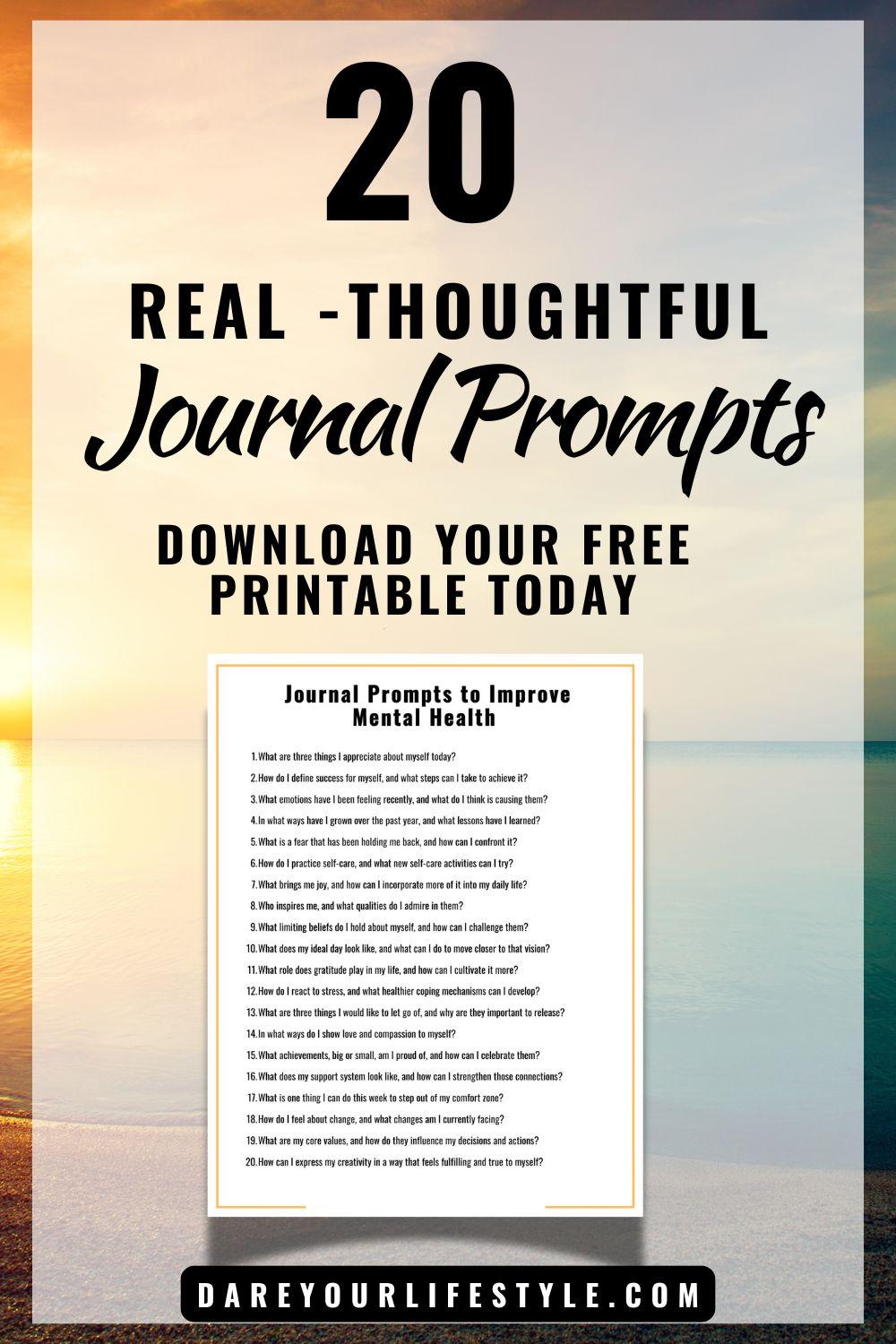
Eight journal prompts for the days your mind feels crowded
You do not need to write three pages.
Five honest lines can be more useful than an hour of staring at an empty journal because you think journaling has to sound deep.
Try one question.
When you do not know what you feel
What emotion keeps showing up this week, and what seems to happen before it?
When gratitude feels forced
What is one small thing I genuinely appreciated today?
Not what you think you should appreciate.
What actually helped?
When something keeps following you around
What am I still carrying that I may need to talk about, change or release?
When you are being harder on yourself than everybody else
What would I say to a friend living through the same week?
Now read your answer back to yourself.
When you think you have made no progress
What did I do this week that helped me, even a little?
When fear keeps delaying something
What am I avoiding, and what is the smallest safe action I can take?
When you have gone quiet
Who makes me feel safe enough to be honest, and when did I last let them know how I was doing?
When your life feels out of sync
What matters to me right now, and does the way I am spending my time match that?
Four mental-health apps that still have a clear job
An app should make something easier.
If it becomes one more notification making you feel guilty, delete it.
These four were part of the original resource list, and they still have clear uses today.
Headspace
Good if you want guided meditation and sleep exercises but do not know where to begin.
The current official Headspace app includes guided meditation, sleep resources and structured programs.
Best for: somebody who wants structure.
Skip it if: you do not want another subscription or you already have a meditation routine that works.
Calm
I liked the sleep side of this one.
The official Calm app includes meditation, Sleep Stories, music and sleep content.
Best for: winding down at night.
Skip it if: free audio or a plain sleep routine already does the job.
Moodfit
This one has a different job.
It is more useful if you want to track mood and notice patterns between things such as sleep, habits and how you feel.
The official Moodfit website lists mood journaling, gratitude, breathing, mindfulness, CBT-style thought records and tracking tools.
Best for: somebody who likes seeing patterns.
Skip it if: tracking yourself starts making you more anxious.
Insight Timer
This is the one I would look at first if cost is stopping you.
The official Insight Timer has a large free library plus a free meditation timer.
Best for: free guided sessions and a simple timer.
Skip it if: having thousands of choices makes you spend more time choosing than meditating.
No app replaces professional care when professional care is what you need.
Four books I kept on the original list
I am keeping the book section simple.
No giant product roundup.
No pretending you need to buy four books to take care of yourself.
The source included these four.
The Gifts of Imperfection by Brené Brown
A good fit for the part of you that is tired of performing as though you have everything together.
Atomic Habits by James Clear
Not a mental-health treatment book.
I included it because the seven-step experiment depended on small repeated actions rather than one huge change.
Feel the Fear and Do It Anyway by Susan Jeffers
More focused on fear, avoidance and taking action while fear is still present.
The Power of Now by Eckhart Tolle
The original list included it because of its focus on bringing attention back to the present.
As a faith-rooted reader, I would still filter any book through your own beliefs instead of accepting every spiritual idea simply because the rest of the book helped.
10 short mental-health quotes for the days you feel off
I am keeping the original section count at 10, but these are original lines rather than another pile of recycled internet quotes.
- “You are allowed to care for your mind before you reach your limit.”
- “A bad week is information, not your identity.”
- “Rest can be part of the work.”
- “You do not have to hide the struggle before asking for help.”
- “One small healthy choice can still count today.”
- “Your mind needs kindness too.”
- “You can be grateful and still admit you are tired.”
- “God is not scared of the part of you that feels messy.”
- “Getting help can be an act of courage and wisdom.”
- “Feeling better slowly is still feeling better.”
15 affirmations for caring for your mental health
Affirmations should not ask you to lie to yourself.
If you feel awful, saying “Everything is perfect” 20 times does not suddenly make it true.
Use words you can stand behind.
- I am allowed to care for myself before I am exhausted.
- I do not have to solve every problem today.
- I can ask for help without feeling ashamed.
- My need for rest deserves respect.
- I can say no without writing a long defence.
- I can notice a difficult thought without believing every word of it.
- I am learning what helps my mind feel steadier.
- I can step away from noise that leaves me feeling worse.
- I am allowed to move at a slower pace during a hard season.
- I can reach out instead of carrying everything quietly.
- I can take one healthy step before I know the whole plan.
- My difficult days do not erase the progress I have made.
- God is with me while I care for my mind and body.
- I can seek skilled help and still stand firmly in faith.
- I will keep showing up for myself one day at a time.
If you want more simple daily statements, these short positive affirmations can give you more
You do not have to get better perfectly
I started this article by telling you I got close enough to a breaking point to know I needed to change something.
Six weeks later, my life was not perfect.
Neither was my mind.
But I was sleeping.
I was walking.
I was talking to people again.
I was getting help.
I was laughing again.
That mattered.
You do not have to improve mental health overnight.
You do not have to do seven things tomorrow.
Pick one.
If sleep is a mess, start there.
If you have been hiding from everybody, text one safe person.
If you know you need professional help, make the call.
If your mind has had no quiet for weeks, give it five minutes.
And pray.
Not because prayer means you should handle everything by yourself.
Pray because God can meet you while you take the next wise step.
One step.
Then another.
That is how my six weeks started too.
Journal Prompts to Improve Mental Health PDF Download
Wrapping it up
I’m not going to tell you these seven steps will fix everything.
Mental health is complex, and what works is personal. But these are the things that worked for me — tried in real conditions, when things felt genuinely hard, by someone who isn’t a professional but is a real human who made it through.
The most important thing I learned? You don’t have to do it all at once. You don’t have to do it perfectly. You just have to keep showing up — to the walk, to the sleep routine, to the five minutes of stillness in the morning — until one day the doing becomes the feeling.
A month and a half. Seven steps. Rinse and repeat. It works.








[…] more about your mental health can be a useful starting point, and a qualified professional can help if the fear keeps shrinking […]